

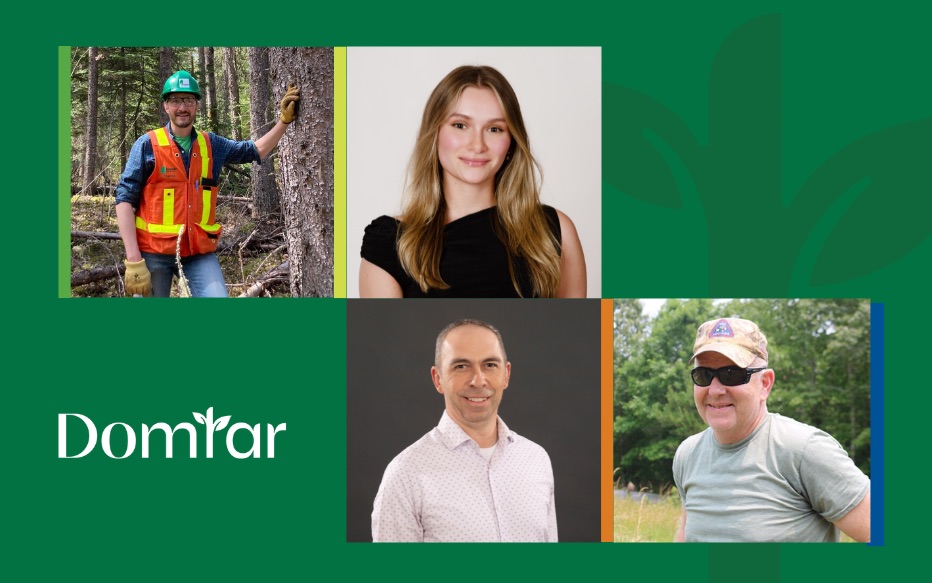
Forest Week marks a time to celebrate the professionals who dedicate their expertise to the care of forests, while also reflecting on the vital role these ecosystems play in the environment, the economy, and daily life. Forests sustain biodiversity, provide renewable resources, and support thousands of jobs including those held by foresters and forest engineers at Domtar.
Within the company, forest engineers stand at the core of sustainable forest management. Their responsibilities range from planning responsible harvests to safeguarding wildlife habitats, ensuring that forests remain healthy and productive for generations to come.
To provide an inside look at the profession, Domtar’s forestry team offered a behind-the-scenes perspective in conjunction with Forest Week. Insights revealed what a day in the wood’s entails, the challenges and rewards encountered, and the driving forces that continue to fuel passion for the forestry profession.
For Jonathan Perron, Senior Forestry Manager for the Lac-Saint-Jean, Mauricie and Côte Nord Woodlands, the work of a forest engineer is anything but routine. Each day demands adaptability from harvest planning and compliance checks to collaborating with governments, rights holders and First Nations communities. The true value of forest engineers, he emphasised, lies in their ability to bridge science and society: making decisions that range from biological expertise to facilitating community consultations. While balancing competing interests can be one of the toughest challenges, Perron notes that the greatest reward comes when diverse stakeholders unite behind a shared vision for sustainable forestry.
For Laurence Caron, Forest Engineer of Lac-Saint-Jean Woodlands, sustainability is at the heart of the profession. The role of forest engineers takes many forms from designing low impact harvesting systems and planning road networks to managing forest fire risks. In her case, the focus lies in ensuring that all fieldwork complies with laws and regulations, providing a foundation for responsible and sustainable forest use.
Looking ahead, Caron saw the profession evolving alongside technology. While demand for wood as a renewable, ecological resource remains constant, tools such as digital mapping and drones are reshaping the way forests are monitored and managed. Yet, she noted, field presence will always remain essential to understand the landscape. Adding to the excitement of her work, Caron will soon appear on Vie de chantier, a Quebec television programme reaching hundreds of thousands of viewers, where she will share insights into the daily realities of forestry and highlight the broader impact of sustainable forest management.
For Chuck Daniels, Procurement Forester at Plymouth Mill, the relationship between forestry and private landowners is central to sustainable supply. With about 80 per cent of the mill’s timber sourced from small landowners, he highlights how each landowner brings unique priorities from wildlife preservation and water protection to family gatherings and tourism. Importantly, Daniels underscores that managing land for timber inherently supports these other goals, making them complementary rather than competing interests.
As both a forester and a landowner, Daniels brings a rare dual perspective to forestry advocacy. His personal experience managing land not only strengthens his credibility but also deepens connections with fellow landowners, who see him as both a peer and a professional. This blend of industry insight and personal stewardship allows him to champion sustainable forestry with authenticity, reinforcing the idea that forest management is about more than timber but also community and shared responsibility.
Working with a renewable resource brings a unique sense of reward, according to Charles-André Préfontaine, General Manager of Lac-Saint-Jean and Mauricie Woodlands. Few experiences compare to returning to a harvested area years later and witnessing the forest regenerate, a tangible reminder of the natural cycle of the boreal ecosystem. Yet, alongside this renewal comes the ongoing challenge of countering misconceptions about forestry practices. With over two centuries of forest management in the Lac-Saint-Jean region and less than 1 per cent of the territory harvested annually. Préfontaine stresses the importance of education in showing how forestry sustains both the local economy and climate goals.
His career has also been marked by meaningful collaborations with Indigenous communities across the forests he has managed. At every stage, forestry work has been a shared responsibility, creating not only environmental outcomes but also economic opportunities. A long-standing partnership with the Ilnu First Nation of Mashteuiatsh stands out in particular: over the past decade, the collaboration has generated more than 100 jobs in operations and expanded business opportunities for community contractors. For Préfontaine, these milestones demonstrate how forestry can serve as a bridge between sustainability, economy, and cultural connection.
Forestry is more than just managing trees. It is about balancing ecological, economic and social priorities to ensure a sustainable future. At Domtar, this work is made possible by the expertise, passion and commitment of our forest engineers, who practice responsible forest management to ensure our forests continue to thrive and provide benefits for generations to come.


